/CXC_webpage_logo_header-3.png?width=278&height=69&name=CXC_webpage_logo_header-3.png "CXC_webpage_logo_header-3")
The realm of enterprise marketing is often like a world in itself. Only highly intentional and high touch programs make an impact. Yet, many organizations don’t know how to vet an enterprise marketing agency properly.
Firstly, the realm of enterprise marketing is in its own league. Your average VP gets hounded tens if not hundreds of times’ per day. Just illuminating an important problem is not enough. Breaking the ice requires a meaningful, unique and high touch approach.
Most "how to choose a marketing agency" content is written for generic digital marketing, SEO retainers, or paid media. None of it accounts for what actually breaks an enterprise event: the wrong attendees in the room, a vendor who's never worked with a Fortune 500 buying committee, or a partner who can talk strategy but has never filled a table with genuine decision-makers.
If you're evaluating agencies for executive dinners, roundtables, or virtual panels aimed at enterprise buyers, here's what actually separates a capable partner from one that looks good in a pitch deck.
Why generic agency criteria don't hold up for enterprise events
Most agency-selection checklists ask about portfolio breadth, creative concepts, and technology stacks. Those matter for brand activations and trade show booths. They tell you almost nothing about whether an agency can get a VP of Manufacturing from Oracle or Mars into a room with your sales team.
Enterprise event marketing is a different discipline. Success isn't measured by footfall or impressions. It's measured by whether the right seven or fifteen people showed up, whether the conversation was worth their time, and whether it produced qualified pipeline afterwards. That changes what you should be scrutinising.
Ask for proof of genuine delegate acquisition, not just event logistics
Any agency can book a venue and print name cards. Far fewer can consistently get senior enterprise buyers to say yes to an invitation.
Ask specifically:
- How do you source and vet attendees, not just invite a purchased list?
- What's your typical show-up rate for a first-time client?
- Can you show me a delegate list from a comparable programme, with real company names?
A strong answer looks like ConvergeX's Alteryx UK manufacturing roundtable: seven enterprise leaders in the room from Oracle, BAT, Mars, TT Electronics, WPP, Fox's Burton, and Babcock, producing five qualified meetings and a 71% conversion rate. That's the kind of proof worth asking for. If an agency can't point to specific companies and specific outcomes, treat "we have great relationships" as a claim, not evidence.
Account-based marketing (ABM) Integration
ABM and enterprise marketing go hand-in-hand, and it’s no surprise either. Event’s are amazing to open a new conversation with an account you just could never get through to before. However, having an ABM strategy is key.
Why it matters: The agency you’ll work with needs to be well versed with working with ABM regional account list or named account list.
This means a good agency will integrate well with your overall ABM plan. In action, this means giving priority to a named account, ensuring direct competitors don’t attend and the attendees understand the topics.
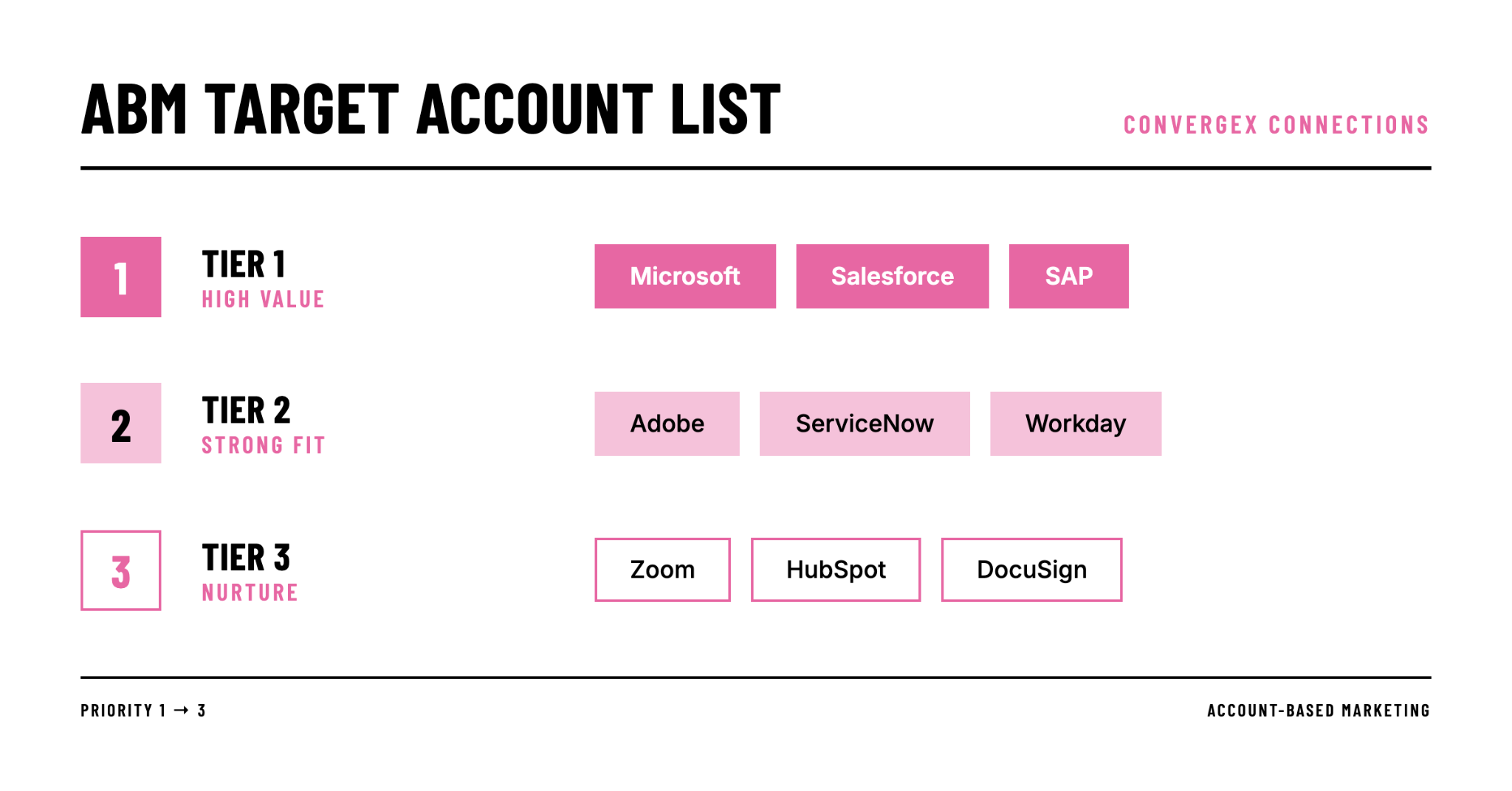
We always recommend structuring a priority system that is easily understood by marketing and sales for ABM to work. Unlike traditional tactics like, ABM requires all hands on deck. The whole revenue function must be on the same page, that includes agencies as well.
Treating your agency partner as a part of the team is a game-changer and vice versa. With ABM high priority accounts means a high level of focus and alignment.
Check that they can flex across formats, not just run one type of event
Enterprise buyers don't respond to a single format. A CISO might be worth a seat at an intimate dinner. A manufacturing leadership team might be better suited to a virtual roundtable. Your agency should be able to move between them based on the audience, not push you towards whatever they're set up to deliver.
Look for range across:
- Executive dinners (typically 10 to 20 senior attendees)
- Micro dinners for secondary cities, where a full-scale dinner isn't viable
- Roundtables, in-person or virtual, with structured discussion rather than a straight presentation
- Virtual panels with genuine moderation, not a webinar with a host reading questions off a screen
If an agency only offers one format regardless of your brief, that's a sign they're fitting your problem to their product, not the other way round.
Look for verifiable case studies with named companies, not vague success stories
"We helped a leading SaaS company achieve outstanding results" tells you nothing. It's unverifiable by design.
Enterprise buyers increasingly research vendors the way they research anything else: checking whether the proof holds up. An agency confident in its work will show you specifics. ConvergeX's Vimeo executive dinner in New York, for example, brought fifteen senior leaders to the table from IFF, US Bank, Chase, Citi, Sanofi, JPMorgan Chase, and Elevance Health. That level of detail, real companies, real numbers, is what separates a credible agency from one padding a pitch deck.
When you're reviewing case studies, ask:
- Can you name the companies that attended, not just the client who paid?
- What was the actual outcome, in numbers, not adjectives?
- Can I speak to a reference client from a similar programme?
- Which industries do you support
Confirm they understand what they're not built for
This is the one most buyers skip, and it's often the most revealing question you can ask.
A specialist enterprise event agency should be able to tell you clearly what falls outside their scope: consumer events, exhibition stand design, venue-booking-only services, brand identity or creative design work, non-enterprise audiences, pure demand generation with no field component, or speaker-for-hire bookings. An agency that says yes to everything is either overselling its capability or subcontracting parts of the work without telling you.
A partner who can say "that's not what we do, but here's who does it well" is more trustworthy than one who nods along to every request.
Questions to ask before you sign
Bring these into your first call, not the contract stage:
- Walk me through how you sourced attendees for your last three programmes in my industry.
- What's your typical timeline from kickoff to event date?
- How do you handle a delegate cancelling close to the event?
- What does post-event follow-up look like, and whose responsibility is it?
- Can I see a full attendee list, with companies and titles, from a recent event?
- What's included in your published pricing, and what typically gets added as scope creep?
If an agency is vague on any of these, especially the pricing and attendee-proof questions, that's worth pressing on before you commit budget.
Red flags to watch for
- No named attendee proof. If every case study is anonymised, ask why.
- One format, sold as flexible. If dinners, roundtables, and virtual panels all get pitched with identical language, they likely haven't run all three well.
- Vague delegate acquisition process. "We have a strong network" isn't a process. Ask how they actually source and qualify attendees.
- No clarity on what they don't do. An agency that claims full-service everything, from creative branding to exhibition stands to enterprise dinners, is rarely excellent at all of it.
- Pricing that only appears after a call. Published, scoped pricing (even as a range) signals a business that knows its own cost structure.
What good looks like
The right enterprise event marketing partner should be able to show you, unprompted: real delegate lists with recognisable enterprise names, format flexibility that matches your audience rather than their default product, and a clear sense of where their expertise ends. If they can do that, the rest of the evaluation, chemistry, communication, and commercials, becomes much easier to judge.
If you're weighing up whether to bring event marketing in-house or hand it to a specialist agency, it's worth looking at what a dedicated enterprise event marketing service actually includes, or reviewing real executive roundtable and executive dinner case studies to see this evaluation criteria applied in practice.
Moaaz Nagori | Head of Marketing
Moaaz Nagori is ConvergexConnection's Head of Marketing. Moaaz has over 7 years experience in B2B Marketing & 3+ years in Sales. He's also worked with over 30 B2B SaaS, and services organizations on optimizing their sales and GTM processes during his tenure as a Co-founder at Cloudlead. Moaaz's areas of interest include event marketing, sales intelligence, go-to-market strategy, and sales & marketing strategy. He also holds a Master's Degree in Marketing & Business Management and also completed his practical Entrepreneurship studies at Draper University.