/CXC_webpage_logo_header-3.png?width=278&height=69&name=CXC_webpage_logo_header-3.png "CXC_webpage_logo_header-3")
There is a moment, about forty minutes into a good executive roundtable, when the room changes.
The small talk is gone. A CISO says the thing she would never put in a webinar chat. A VP three seats down leans in because he is fighting the exact same fire and thought he was the only one. Nobody is pitching. Nobody is being pitched to. And that single conversation will go on to influence more pipeline than the last six months of paid social combined.
That is the quiet power of the format. It is also why it gets butchered so often.
Most teams treat an executive roundtable as a fancy dinner with a logo on the menu. The teams that win treat it as a system: a way to get senior buyers into a room, build real trust, and keep the conversation going long after the plates are cleared. This guide is about how to run the second kind.
.png?width=477&height=477&name=Untitled%20design%20(24).png)
What is an executive roundtable?
An executive roundtable is a small, invitation-only gathering, usually 8 to 15 senior decision-makers, built around a focused discussion of a shared challenge rather than a presentation. There is no audience and no stage. Everyone at the table is a participant, including the host. The format prioritizes peer-to-peer conversation, candor, and connection over reach.
That is the textbook definition. Here is the part the textbooks skip: the value is not the content. Executives can read a report. What they cannot get anywhere else is a confidential room full of peers who are wrestling with the same problem at the same scale. A CIO does not give up an evening to hear your product roadmap. She gives up an evening to find out how four other CIOs are handling the exact thing keeping her up at night.
Get that distinction wrong and you will spend a fortune on catering and learn nothing.
Roundtables come in a few flavors, and the names overlap depending on who you ask: leadership roundtables, industry roundtables, C-suite roundtables, peer networking events, and the broader family of executive networking events and account-based marketing events. The mechanics are similar. The difference is who is in the room and what they are there to solve.
Virtual or in person? Picking the right roundtable
Here is the question that trips most teams up. Should the roundtable happen over dinner, or over video?
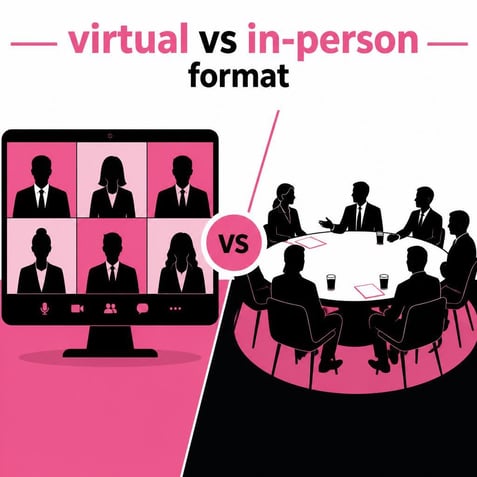
The honest answer is that they are not competing options. They are different tools for different stages of a relationship, and treating one as a budget version of the other is where programs go wrong.
An in-person executive roundtable, usually a dinner, is the heavyweight. Breaking bread with a small group builds trust faster than anything else in B2B. People relax, they speak candidly about the failures they would never admit on a webinar, and the conversation carries a weight that a screen cannot match. It is also the format that tends to convert to pipeline fastest. The trade-off is obvious: it costs more, it takes more to organize, and your guest list is limited to whoever can physically get to the room.
A virtual roundtable flips every one of those trade-offs. There is no travel, no venue bill, and a busy VP is far more likely to say yes to sixty minutes on video than an evening across town. You can put a CMO in London and a CRO in New York at the same table without anyone booking a flight. The catch is that screens invite distraction, the bonding is shallower, and someone is always quietly answering Slack under the desk. Candor is harder to protect, and deals tend to move a little more slowly off the back of it.
So how do you choose? Match the format to where the relationship actually is. Cold or early-stage accounts, or a group spread across regions, lean virtual. The high-value accounts you are serious about closing deserve a seat at a dinner.
The smartest programs do not really choose at all. They sequence. Use a virtual roundtable to open the relationship and find the accounts worth pursuing, then invite the best fits to an intimate in-person dinner where the real progress happens.
One rule holds for both. A virtual roundtable is not a webinar with the cameras on. Keep it small, keep everyone talking, and protect the conversation. The moment it turns into a presentation, you have lost the only thing that made it worth doing in the first place.
Why executive roundtables matter more now, not less
You would think that in a world of endless digital channels, the case for getting fifteen people in a room would be getting weaker. The opposite is true.
In-person events are now the most impactful channel many organizers have. Bizzabo's research has consistently shown roughly eight in ten organizers rating in-person events as vital to hitting their objectives. A separate Endeavor survey, reported by eMarketer, found 60% of B2B marketers consider in-person events an effective lead generation tactic. Buyers are drowning in automated email and templated LinkedIn outreach, and the one thing that still cuts through is a real conversation with real peers.
At the same time, the squeeze is on. The Global State of B2B Events 2025 survey found 69% of event leaders facing flat or shrinking budgets. So you have a channel that works better than almost anything else, and finance asking you to do it for less. That combination is exactly why the roundtable is having its moment. It is the highest-trust format per dollar in B2B, when it is run well.
And here is the encouraging shift. Bizzabo's 2026 benchmark found that 40% of organizers still struggle to prove event ROI, which sounds grim until you see it was 70% the year before. Teams are getting better at measuring this stuff. The ones who do are the ones still standing when budgets get reviewed.
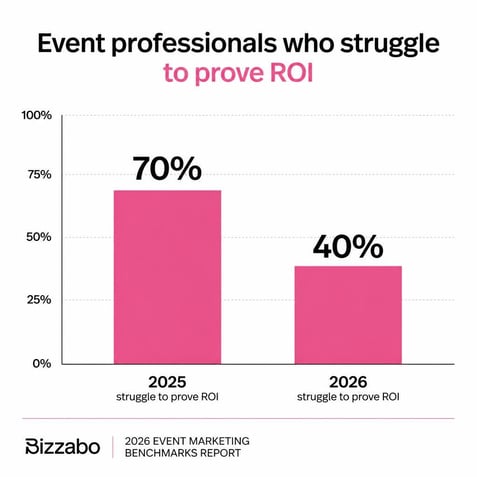 This shift isn't random. It's a testament that event and field marketing leaders are prioritizing ROI. This is excellent news for the industry but that means our understanding of events needs to match that shift.
What to know before you host your first roundtable
Before we get to the playbook, a few honest expectations.
This is not a volume channel. If your CMO wants 500 names by Friday, a roundtable is the wrong tool. A roundtable might produce twelve attendees. But those twelve could be twelve target accounts you have been trying to reach for eight months. Quality over quantity is not a slogan here, it is the entire premise.
It is also not cheap per head. A good private dinner can run a meaningful amount once you count venue, food, travel, and a skilled facilitator. The math only works if you treat the attendees as accounts, not leads. One closed enterprise deal pays for a year of dinners.
And it is not a quick win. The conversation in the room is the start of the relationship, not the finish line. Which brings us to the single biggest mistake in the category, and the thing this whole guide hinges on.
The myth worth killing: attendance is the metric that matters. It is not. A packed room that nobody follows up with is a very expensive party. The metric that matters is what happens in the ninety days after.
The 3C model: how to make a roundtable actually deliver
After running enough of these to know what separates the events that print pipeline from the ones that just print invoices, the pattern comes down to three phases. We call it the 3C model: Curation, Conversation, Continuation. Most teams obsess over the middle one and ignore the bookends. The bookends are where the money is.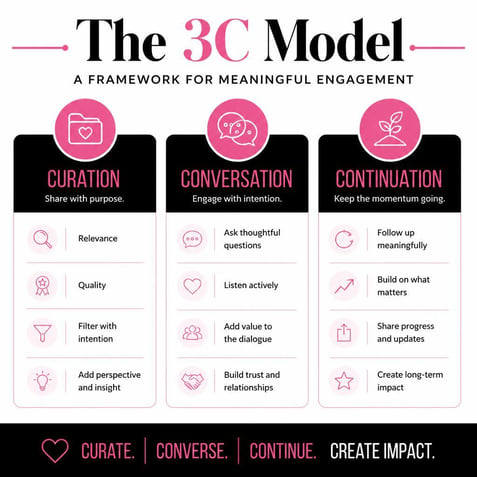
Here are the seven factors that sit inside those three phases.
Curation: getting the right room
1. Pick a problem, not a product. The topic is your invitation. "A discussion on AI governance for regulated industries" gets a CISO to clear her calendar. "Learn how Acme reduces risk" gets your email deleted. Frame the session around a problem your ideal attendees genuinely lose sleep over, and make the framing peer-led, not vendor-led. If the topic could double as a sales deck title, start over.
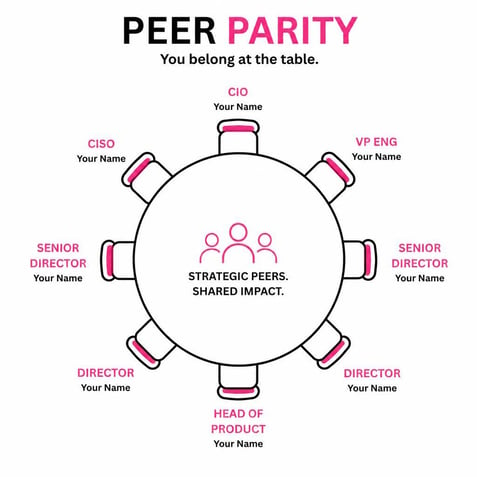
2. Curate the room like a dinner party, not a webinar. The fastest way to ruin a roundtable is mismatched seniority. Put a senior manager next to a CEO and one of them stops talking. Senior directors at an enterprise organization can be strategic leaders as well, so make sure to not cloud your mind with VP's and C-suite only either. Directors and heads can be a key entry to the c-suite.
Aim for peer parity: similar seniority, complementary industries, no direct competitors who will clam up. Eight to fifteen people is the sweet spot. Fewer than six feels thin. More than fifteen and it quietly becomes a panel with bad acoustics.
3. Earn the invitation. This is where most programs fall apart, and where genuine network strength and real personalization separate the operators from the amateurs. Senior buyers ignore generic invites. Think out of the box. A well-timed gift can lift attendance. There's a reason why personalized gifting increases booth traffic by 40%. It works.
You're looking to build relationships that will fuel pipeline in the millions. A thoughtful gift goes a long wya. They respond to a note that shows you understand their world, ideally from someone they already trust.
Getting a room of enterprise leaders to say yes is not a volume game of blasting 4,000 contacts. It is a precision game of reaching the right 40 in a way that feels personal and worth their evening. If you cannot fill the room with the right people, the format does not work, full stop.
Conversation: making the room work
4. Match the format to the goal. Not every roundtable is a dinner. A dinner of 10 to 15 is best for relationship building and candid talk about sensitive topics. A breakfast or lunch workshop suits a more structured agenda with a framework to work through.
A virtual roundtable extends reach across regions and works surprisingly well for early-stage relationships, though it converts to deals more slowly than breaking bread in person. Pick the format that fits the outcome you actually want, then design backward from there.
5. Facilitate, do not present. The single biggest in-room error is letting the host turn the evening into a pitch. The moment a slide deck appears, the trust evaporates and so does the candor.
A skilled, neutral moderator is worth their weight in pipeline. Their job is to keep the conversation balanced, draw out the quiet expert at the end of the table, gently move past the person who will not stop talking, and protect the confidentiality that makes people honest. Run it under a Chatham House style understanding so guests know they can share real failures, not sanitized wins.
Here's an excellent piece on an exclusive interview on why contribution beats attendance.
Continuation: where the deals actually happen
6. Continue the conversation, or you have wasted the whole thing. This is the heart of it, and it is where the entire industry quietly fails. Research across the field suggests only around 18% of event leads ever get meaningful follow-up, while a fast, well-timed first response wins a large share of deals. Read that again. Most companies pay a premium to fill a room with senior buyers and then let the relationship die in the inbox.
An executive roundtable is not over when dessert arrives. The conversation has only started. The host needs a deliberate post-event motion: a thoughtful recap, a personal note that references what the attendee actually said, an offer of genuine value, and a clear, low-friction path to a real meeting.
This is the difference between a roundtable that builds pipeline and one that builds nothing but a nice photo for LinkedIn. If you take one thing from this guide, take this one.
7. Measure what matters. Headcount is a vanity metric. The numbers worth tracking are cost per qualified meeting, opportunities and pipeline influenced, deal velocity for accounts that attended versus those that did not, and pipeline-to-cost ratio.
A useful benchmark to aim for is several dollars of influenced pipeline for every dollar spent. Define your success metrics before the event, not after. As the old field-marketing line goes, if you cannot agree on what good looks like before the event, you will spend the next quarter arguing about it.
A quick, honest word on the math
Say a single roundtable costs you a meaningful five-figure sum once everything is counted. If that room of twelve produces even two or three qualified enterprise opportunities, and enterprise deals in your world run well into six figures, the channel is not expensive. It is one of the cheapest paths to a boardroom you will ever find. Chili Piper has shared publicly that its micro-events convert leads at materially higher rates and lower cost than large trade shows. The pattern holds across the category: small and curated beats large and generic on almost every deal-per-attendee metric.
The expensive version is the one where you nail the room, nail the conversation, and then do nothing with it.
Why marketers are sick of event vendors (and where the real gap is)
Let us name the thing.
If you have spent any time in this market, you have been promised a room of fifty CISOs by a vendor who then delivered fifteen junior managers and a confirmation email written in Comic Sans energy. You have heard the same guarantees from a dozen companies who all sound identical. And you have watched the relationship go cold the second the event ended, because the vendor's job, in their mind, was to fill seats, not to build pipeline.
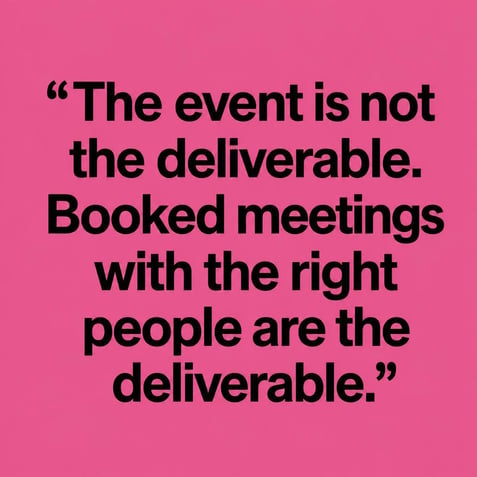
That is the gap. The market is crowded with companies who treat the event as the deliverable. The event is not the deliverable. Booked meetings with the right people are the deliverable.
The model that actually works pairs serious curation muscle (the network and personalization to get genuinely senior people in the room) with a refusal to disappear afterward. The follow-up, the introductions, the handoff to your sales team, the patience to turn a great conversation into a real meeting: that is the unglamorous work where roundtables either pay off or quietly do not. It is also the work most vendors skip, because it is harder than booking a restaurant.
If a partner cannot tell you how they will translate the event into a continued conversation. You're scheduling a party, not an executive roundtable discussion.
It's called a discussion because it's supposed to continue, post-event. Accepted meetings with those executives speaks volumes.
So, what now?
Executive roundtables are not complicated, but they are unforgiving. Get the room right, keep the host out of pitch mode, and treat the days after the event as more important than the event itself, and you have one of the most effective pipeline channels in B2B. Get any of those wrong and you have a lovely dinner with no return.
If you want a partner who handles the hard parts (getting genuinely senior people in the room, running the conversation, and actually turning it into booked meetings for your sales team) that is the entire reason ConvergeX Connections exists.
Book a call with our team to talk through a roundtable program built for your accounts, not a generic guest list.

Moaaz Nagori | Head of Marketing
Moaaz Nagori is ConvergexConnection's Head of Marketing. Moaaz has over 7 years experience in B2B Marketing & 3+ years in Sales. He's also worked with over 30 B2B SaaS, and services organizations on optimizing their sales and GTM processes during his tenure as a Co-founder at Cloudlead. Moaaz's areas of interest include event marketing, sales intelligence, go-to-market strategy, and sales & marketing strategy. He also holds a Master's Degree in Marketing & Business Management and also completed his practical Entrepreneurship studies at Draper University.